Price: 644.00‎€  523.00‎€

* Exam Language:
* Peoplecert Voucher code validity:

The voucher allows you to take the online exam with the Examination Institute. You will receive the exam voucher code as of the purchase date. In any case, ExamSimul reserves the right to send the exam voucher in every moment after the purchase.
The voucher is valid for 12 months from the date of issue.

Peoplecert | Rescheduling an exam up to 48 hours before the start time is free of charge, for more information please click here.

* eBook Language:

Please select the eBook language.

* Learning Resouce Kit:

Choose your Learning Resource Kit language

- +

The ITIL® Foundation (Version 5) Exam Bundle is the ideal self-study solution for professionals who prefer a focused and essential preparation path. This package provides the core official resources needed to understand and apply ITIL v5 concepts, including AI-enabled service management, digital operating models, and sustainable value creation.

The ITIL® Foundation (Version 5) exam is delivered by BITIL.COM, an Accredited Examination Organization (AEO) of PeopleCert®.

This Exam Bundle includes:

  • Official eBook – comprehensive digital guide covering ITIL® v5 concepts, framework, and practices.
  • Exam Voucher – official voucher with online proctoring for convenient remote exam delivery.
  • Learning Resource Kit – structured study materials designed to support effective exam preparation.

Note: Purchasing the ITIL® Foundation (Version 5) Exam Bundle fulfills the mandatory requirement to access the certification exam.

Frequently Asked Questions

  • Important information

    Activation may take up to 6 hours (usually within a few minutes), as it is handled manually. Once your access is activated, you will receive a confirmation email. If you experience any delay, please contact us via chat or at [email protected].

Objectives

Students who complete this Exam Bundle will have learned:

  • The key concepts of digital product and service management and the common language used across ITIL (Version 5), including products, services, value co-creation, service relationships and continual improvement
  • How the ITIL Product and Service Lifecycle works — covering the eight activities (Discover, Design, Acquire, Build, Transition, Operate, Deliver, Support) — and how they can be applied iteratively rather than sequentially
  • The ITIL Four Dimensions of Product and Service Management and the external PESTLE factors that influence them
  • The structure and components of the ITIL Value System (Guiding Principles, Governance, Value Chain, Management Practices, Continual Improvement) and how they interconnect to create value
  • How to understand and apply each of the 7 ITIL Guiding Principles and describe how they interact with each other
  • The steps of the ITIL Continual Improvement Model and how to apply them within the ITIL Value System
  • Key concepts of value stream identification, mapping and management, including core and enabling value streams and complexity thinking
  • How Artificial Intelligence (AI) — including GenAI and Agentic AI — can be leveraged throughout the product and service lifecycle, and the fundamentals of ITIL AI Governance and the ITIL AI Capability Model
  • How ITIL (Version 5) complements other frameworks such as DevOps and PRINCE2 in the product and service development lifecycle

Who it is aimed at

  • Individuals at the start of their journey in digital product and service management — no prerequisites required
  • ITSM Managers and aspiring ITSM Managers working in digital and AI-enabled organizations
  • Professionals in digital product teams, development, operations or transformation roles with interface with service delivery
  • Existing ITIL 4 qualification holders wishing to update their knowledge to ITIL (Version 5) via the Foundation Bridge route
  • Enterprises, managed service providers, digital product vendors and professionals seeking a recognized best practice foundation for digital service management

Contents

1. Key ITIL Terms and Definitions (30% of exam)

  • Digital product and service management: products, services, digital products, digital services, goods
  • Utility, warranty, user experience (UX), sustainability
  • Key terms of ITIL Experience: trust, customer experience (CX), experience level agreement, human-centred design
  • Key terms of ITIL Strategy: mission, vision, purpose, VUCA, leadership, digital strategy
  • Key terms of ITIL Transformation: change, transformation, business as usual (BAU)
  • Service offerings: service actions, transfer of goods, access to resources, service interactions
  • Value co-creation: value, output, outcome, cost, risk and how they contribute to co-created value
  • Service relationships: service provider, service consumer, digital product vendor, sponsor, customer, user
  • Basic, cooperative and collaborative service relationships; the service journey; service quality and SLA

2. The ITIL Four Dimensions of Product and Service Management (10% of exam)

  • The four dimensions and the importance of a holistic approach:
    • Organisations and People
    • Information and Technology (including AI and automation)
    • Partners and Suppliers
    • Value Streams and Processes
  • External factors influencing the four dimensions: PESTLE (Political, Economical, Social, Technology, Legal, Environmental)

3. The ITIL Product and Service Lifecycle (10% of exam)

  • Introduction to the ITIL Product and Service Lifecycle (PSLM) and its purpose
  • The eight lifecycle activities — not sequential but iterative:
    • Discover
    • Design
    • Acquire
    • Build
    • Transition
    • Operate
    • Deliver
    • Support
  • Purpose and scope of each lifecycle activity

4. The ITIL Value System (40% of exam)

  • Components of the ITIL Value System and their roles: Guiding Principles, Governance, Value Chain, Management Practices, Continual Improvement
  • The 7 ITIL Guiding Principles and how they interact:
    • Focus on value
    • Start where you are
    • Progress iteratively with feedback
    • Collaborate and promote visibility
    • Think and work holistically
    • Keep it simple and practical
    • Optimize and automate
  • Governance: definition, enabling nature and governance activities
  • Value chain: key terms including product specification, product prototype, incident, event, release, test, CI/CD, reliability, SRE, observability, service request, disaster, problem, error, known error, operating model
  • Management practices: two groups (General Management Practices; Product and Service Management Practices), structure and benefits of ITIL Practice Guides, metrics and CSFs
  • The ITIL Continual Improvement Model: the 7 steps and their application within the Value System

5. Value Stream Identification, Mapping and Management (5% of exam)

  • Key concepts: value stream, core value stream, enabling value stream, complexity thinking
  • Value stream mapping and value stream management: purpose, relationship and elements of a value stream map
  • How workflows need to be optimized for complexity

6. ITIL and AI (2.5% of exam)

  • Definitions: Artificial Intelligence (AI), AI maturity, GenAI, Agentic AI
  • How AI assists across the product and service lifecycle and value chain activities
  • AI Governance: definition, the ITIL AI Capability Model

7. ITIL and Other Frameworks (2.5% of exam)

  • ITIL and DevOps: how they are complementary in the product and service development lifecycle
  • ITIL and PRINCE2: the importance of project management in ITIL and how the two frameworks are complementary

In order to access ITIL® v5 Foundation exam:

  • There are no specific pre-requisites. By the way, some appreciation of the ideas and principles of services may be useful.
  • To be able to take the exam, it's necessary to have read and accepted the terms and conditions of examination institute, available in english. The acceptance of such terms and conditions will have to be confirmed when taking the exam.

The voucher allows you to take the online exam with the Examination Institute PeopleCert. You will receive the exam voucher code as of the activation date of your account on the platform. In any case, we reserves the right to send the exam voucher in every moment after the purchase. The voucher is valid for 12 months from the date of issue.

  • Exam type: Online
  • Certification: ITIL v5 Foundation 
  • Certificate type: Online
  • Language: Chinese, English, French, German, Italian, Japanese, Polish, Portuguese (Brazil), Spanish

The ITIL® Foundation (Version 5) real exam consists of 40 multiple choice questions.

  • The time allowed for the exam is 60 minutes (75 minutes for candidates taking the exam in a language that is not their native or working language)
  • You must achieve 65% or more (26 out of 40 marks) to pass
  • All questions should be attempted — there is no negative marking
  • The exam includes four question styles: Standard, Negative, Missing word(s), and List (select 2 correct items from 4)
  • The exam is closed book — no materials are permitted during the exam

Exam procedure

  1. Prepare your computer
  2. Prepare your environment
  3. Prepare your documents
  4. Starting your exam
  5. Exam experience

For more information about technical requirements and the online exam procedure, please click here.

The official electronic certificate (e-certificate) is provided free of charge and automatically upon passing the exam, and carries the same validity as the paper certificate.

eBook
Version Electronic
Exams
Exam type Online Exam
N. Questions 40 MCQ
Pass Mark 65% = 26 points
Time 60 minutes
Certificates
Certificate type Online
Certification ITIL® v5 Foundation

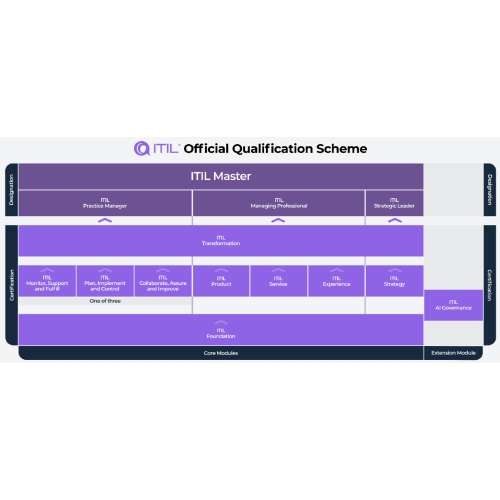
ITIL v5 Certification Path Calculator

Select your current certifications and your goal: only the missing steps will be shown, including Foundation Bridge and Managing Professional Transition (MPT).

Certifications already held

Tip: select all certifications you hold to automatically reduce the proposed steps.

v5 modules already completed (optional)

If MPT is completed, Product, Service, Experience and Transformation are considered covered for the MP path.

Target
Select your options and press Calculate path.

The MPT path requires two separate exams: ITIL Transformation (v5) and ITIL Managing Professional Transition (v5).

Top